Oh a beautiful Bernese Mountain Dog! Sturdy, self-confident, friendly and loyal. But then there is a potential dark side…hip dysplasia, elbow dysplasia, OCD (osteochondritis dissecans) and potentially savings-draining surgeries to try to fix it all.

Unfortunately we have had a huge run on BMDs with these issues lately. While we usually work with senior dogs, we have seen more than our share of young (under 2 years) Berners lately with these musculoskeletal problems. Left untreated, they can and will become the other common senior dog problems we are all familiar with – pain, lameness and osteoarthritis. So what can an owner do when they have a Berner puppy to try to prevent the development of these problems in the first place? Believe it or not, it starts right from the whelping pen!
1. Whelping Pens
Non-slip flooring is important! Consider rubber flooring or rubber backed mats. This allows a pup to get their weight through their feet to push themselves forward which prevents them from flailing about and overextending their hips. When there is too much stress through a developing joint, this leads to laxity. This laxity keeps the ball of the hip from sitting tightly in the socket and a proper “fit” does not form as the dog develops. It’s this poor fit that is diagnosed as hip dysplasia.
2. The Time of Year a Dog is Born
Dogs born in spring and summer and that are born on farms or had ample outdoor activity time in the first 3 months of life have lower rates of hip dysplasia. This has actually been studied and proven to be true! Free-play time on different surfaces encourages the development of the stabilising muscles around the hip. Outdoor play is also typically done on non-slippery surfaces – another reason to give young dogs more traction under their feet inside your house as well. Allow your puppy to explore on different types of surfaces like dirt, mulch, sand, hills, leaves, etc.
Have a fall or winter puppy? You can still mimic this outdoor play indoors by providing different sensory activities that help to develop coordination and muscle strength. Be sure to provide plenty of tractions. Some ideas include:
- Items to step over or in and out of
- Planks of wood, shallow bins, mop/broom handles, etc.
- Tunnels or items to crawl under or through
- A great alternative use for your agility equipment until your pup is developed enough!
- Walking over unstable surfaces
- Cushions from lawn furniture
- Camping foam
- FitPaws equipment

Frankie at 7 months. He has a likely OCD lesion in one shoulder
3. Stairs
Keep your puppy off of the stairs for the first 3 months of life! Doing so has been shown to reduce the incidence of hip dysplasia. When your puppy is older than 3 months it may be advisable to train your dog on steps with a smaller rise, or practice on an old step-up bench so that they are physically able to do stairs without difficulty.
4. Age of Spay/Neuter
More studies are coming out about the effects of age at time of desexing. A 2020 study in the Frontiers of Veterinary Science looked at rates of joint disorders including hip dysplasia, cranial cruciate ligament (CCL) tear/rupture and elbow dysplasia in relation to age at spay and neuter. Males neutered before age of 2 had a 23-24%, or 6-fold increase, in likelihood of a joint disorder vs. intact males. Females spayed before 6 months had a 3-fold increase in risk of a joint disorder but the amount was not statistically significant. The researchers concluded they could not make a recommendation on age of spay for females but recommended delaying neutering males until “well-beyond 2 years”!
5. Healthy Weight
Any extra weight on joints, especially developing ones, is a recipe for disaster. Keep an eye on your dog’s weight using a body condition score chart. You should be able to easily feel the ribs and waist even on a puppy. Do not free feed! Measure or weigh the food you offer your dog and consider using kibbles as training treats or rewards. Too much vitamin D and calcium is hypothesised to contribute to the development of an OCD lesion. Speak to your vet about appropriate nutrition sources for your puppy.
6. Supervised Play
Ideally your puppy should play with similar sized dogs. Supervise your dog and watch for signs of fatigue (awkward movements, slowed reaction times, overstimulation/tantrums/increased aggression) or play with ‘boring’ older dogs. Play should also be on non-slip flooring. Be cautious if considering a dog daycare. It should have non-slip flooring, separate dogs into appropriate groups based on size, have scheduled rest breaks and be supervised!
The goal with young dogs is to protect the cartilage and the growth plates, while supporting the joint with strong muscle. Damage to the cartilage can lead to an OCD lesion. OCD lesions are painful and don’t usually resolve without surgery. Damage to the growth plates can cause abnormal or halted growth of a bone which leads to dysplasia. The elbow joint is particularly susceptible. Abnormal forces through the hip joint during growth can prevent an ideal fit of the bones, leading to hip dysplasia
What else might you consider? Having your puppy seen by a canine rehab therapist or rehab vet for a wellness check to look at things like pelvis alignment, hind end and glute strength, coordination and to teach you appropriate and specific exercises targeted to your dog’s needs. And of course, do your research on reputable breeders, screening tests and all that other stuff that one shouldn’t ignore when bringing home a new dog.
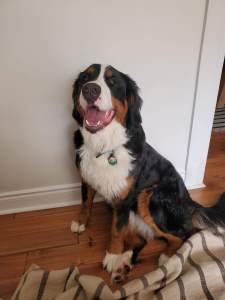
11 month old Eloise “Ellie” 5 months post-op for bilateral shoulder OCD lesions and right elbow dysplasia. Ellie is also waiting to see the surgeon to discuss likely hip dysplasia.
References:
Hart, Benjamin L., et al. “Assisting Decision-Making on Age of Neutering for 35 Breeds of Dogs: Associated Joint Disorders, Cancers, and Urinary Incontinence.” Frontiers in Veterinary Science, vol. 7, 2020, https://doi.org/10.3389/fvets.2020.00388.
Krontveit, Randi I et al. “Housing- and exercise-related risk factors associated with the development of hip dysplasia as determined by radiographic evaluation in a prospective cohort of Newfoundlands, Labrador Retrievers, Leonbergers, and Irish Wolfhounds in Norway.” American journal of veterinary research vol. 73,6 (2012): 838-46. doi:10.2460/ajvr.73.6.838
**This article was originally published in the Summer 2023 Edition of The Bernese Please, the official newsletter of the Bernese Mountain Dog Club of Canada.**