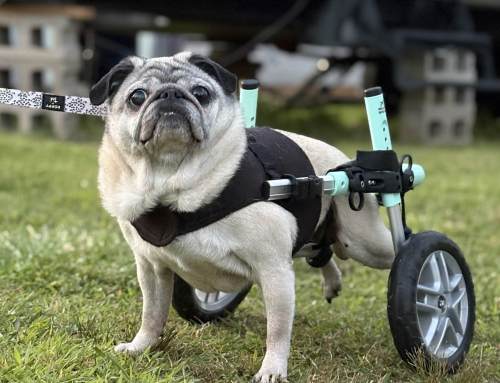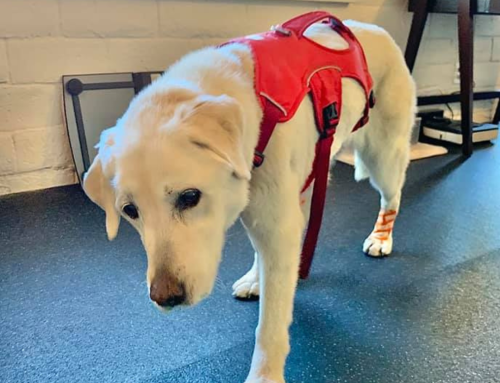
If you share your life with a dog, especially one with arthritis (or any dog with a history or injuries, or other mobility issues), you’ve probably noticed a pattern: when winter hits, movement can look different.

Some things you might notice:
- Slower to get up
- Shorter stride or “stiff” steps at the start of a walk
- Less interest in longer outings
- More slipping
- More hesitating on stairs
- A little extra grumpiness (check our the chronic pain blog series for more)
So… is winter actually making your dog’s joints worse or is it something else?
The honest answer is: for some dogs, winter can absolutely make pain and mobility feel harder—BUT the “why” is usually a mix of biology + behavior, not a single simple cause.
Below is what we know, plus practical ways to help your dog move better all winter long.
Why does winter seem harder for some dogs?
1) Muscles and soft tissues warm up more slowly
Heading out to exercise in the cold is different than when the temperatures are warmer. It takes longer for the body, especially joints and soft tissues, to be ready to move when it’s cold. If your dog already has joint pain, they often compensate with altered movement patterns—so stiff muscles can add to that “rusty” look at the start of activity. Even if your dog has no issues, heading out cold and unprepared for activity can increase the risk of injury.
2) Exercise habits change
Winter often means:
- shorter walks
- less time outside wandering and sniffing (low level activity)
- less traction and confidence on slippery ground
- more time lying around
Less daily movement can lead to more stiffness, and stiffness can lead to less movement. This is a common theme in the development of arthritis: when an owner fears their dog has pain from arthritis, they’ll often get less exercise. Similarily, many dogs get less exercise when the temperature drops or it’s icy outside.
3) Traction changes can increase guarding and “pain behaviors”
Even if your dog’s joints aren’t dramatically worse, winter surfaces can make them move more cautiously. That guarded movement can look like pain—and can create pain if they slip, twist, or brace repeatedly. And while we can appreciate that ice outdoors in slippery, don’t forget about wet paws on slippery floors inside is also a factor.
4) Some dogs may be “weather sensitive,” but it varies
In humans with OA, research often finds small-to-modest links between weather variables (like temperature, humidity, barometric pressure) and pain. A 2023 systematic review/meta-analysis reported associations where higher humidity and barometric pressure correlated with higher OA pain, while temperature correlated negatively (colder temperatures associated with higher pain).
That said, not every study agrees, and “average effects” can hide big individual differences—some individuals are clearly sensitive, others not at all.
5) New Research Shows that Cold Temperatures Worsen Arthritis in the Joint
A 2025 study showed that cold climates affected the temperatures inside of a joint, allowing for fat accumulation and worsening of osteoarthritis in mice. This new evidence suggests that living in colder climates (versus moderate) leads to worsening of osteoarthritis.
Signs that dogs with osteoarthritis are struggling in winter
- Slowness in rising or stiffness – especially first thing in the morning or after a long nap.
- Reduced range of motion – Not always dramatic, but you might notice less hip extension, less knee bend, or more “bunny hopping” in the back end.
- More compensation patterns – Toe dragging, head bobbing, leaning to one side, avoiding certain positions, or reluctance with stairs/vehicles.
- Confidence dips – Dogs remember things that caused pain. One bad slide on ice can create a lasting hesitation pattern that reduces activity

Actionable steps to help your dog conquer winter!
1) Warm-up before you ask for effort (2–5 minutes)
Think of this like “starting the engine.”
Try:
- Walking around the house before heading out
- gentle figure-8s in the house
- a few controlled sit-to-stands (if appropriate for your dog)
- slow cookie stretches (nose to shoulder/hip—no forcing, but no long holds)
Goal: Raise the body temperature and prepare the body for exercise so that it stays warm when heading out
2) Prioritize traction (this is a big one)
Winter surfaces can be the difference between “fine” and “struggling.”
Options:
- boots (especially for ice melt/salt and gripping)
- paw wax or traction balm
- toe grips (for indoor slipping)
- non-slip flooring (mats and runners)
- keep nails and paw fur trimmed for better contact
It’s easy to become complacent and not think that our dog’s slipping is an issue, but consider each slip is a micro-injury and all those micro injuries can add up over time.
3) Keep outings shorter—but more frequent
A long cold walk can tighten things up, while frequent short walks keep joints lubricated. Your dog’s breed and health will be important factors in whether or not the walk routine needs changing.
A simple winter rhythm:
- 2–4 short walks/day
- one slightly longer walk during the warmest window (if safe)
4) Replace “lost” outdoor activity with indoor movement
If weather reduces your dog’s usual activity, aim to replace it so stiffness doesn’t snowball.
Ideas:
- practice obedience skills
- conditioning exercises (provided by a physio or a canine fitness trainer)
- brain games
5) Appropriate bedding
- a warm bed (off cold floors) and kept away from drafts
- make sure the bed is kept dry (melting snow may not dry under you dog)
6) Keep the “basics” dialed in
Winter is when small gaps in the plan become obvious:
- Weight management (extra pounds amplify joint load)
- Strength work (targeted strengthening often improves function more than people expect)
- Mobility work (range-of-motion, flexibility, controlled movement)
- Medication/supplement plan with your vet (don’t wait for a big flare)
Signs that your dog needs more help this winter
Some change is expected. But these are signs your dog needs a vet check and/or a rehab reassessment:
- limping that has been going on for more than a few days, is new, or persists
- pain signs at rest (panting, licking, restlessness, trouble settling)
- new reluctance with stairs, jumping, car entry
- repeated slipping or sudden yelps
- noticeable weakness, knuckling, or dragging
- sudden change after a slip/fall
Winter doesn’t just “flare arthritis”—it can also reveal new injuries or progression that deserves attention.
If you need help, consider working with Pawsitively Fit. You can request a call back here.
References
Hall, Emily J et al. “Exploring Owner Perceptions of the Impacts of Seasonal Weather Variations on Canine Activity and Potential Consequences for Human-Canine Relationships.” Animals : an open access journal from MDPI vol. 11,11 3302. 19 Nov. 2021, doi:10.3390/ani11113302
Wang, Lin et al. “Associations between weather conditions and osteoarthritis pain: a systematic review and meta-analysis.” Annals of medicine vol. 55,1 (2023): 2196439. doi:10.1080/07853890.2023.2196439
Zhang Y, Fu M, Zhou C, et al. Cold exposure promotes the progression of osteoarthritis through downregulating APOE in cartilage. EMBO Mol Med. 2025;17(8):2137-2162. doi:10.1038/s44321-025-00268-6